Showing posts sorted by relevance for query solar. Sort by date Show all posts

March 6, 2008

The Solar Power Push

Everyday it blazes across the sky and shares more energy with the Earth than humans could ever hope to use. The greatest energy factories on Earth use its never ending supply of high power radiation to assimilate carbon, produce oxygen, and feed the world. If we add up all the power that could ever be harvested by our oil and coal deposits, it would laugh and produce the same in a 24 hour span. Yet everyday we see the sun rise and set and rarely contemplate just how important that glowing ball of plasma is.

The energy from sunlight falling on only 9% of the California's Mojave Desert could power all of the United States' electricity needs if the energy could be efficiently harvested. Really? So if we could dedicate 9% of unusable desert land to solar energy production we could turn all of our coal and gas power plants off? That sounds like a great future technology, but the truth is with the right incubation and nurturing of technology this type of energy production is just around the corner.

A team at Northwestern recently discovered a new way to make solar cells that boosted their efficiency "by approximately 40 percent and the power conversion efficiency from approximately 3 to 4 percent to 5.2 to 5.6 percent." I know those numbers don't mean a lot to you non-science folks, but they are quite amazing for such a simple solution. The group is continuing to do work on recovering efficiency within the system and the results look promising to further increasing the ability to store solar electricity. There are numerous advances within the efficiency of solar capture and conversion.

A great advantage to solar cells is their ease of production. Many cells are now produced just like a newspaper, with huge sheets of malleable plastic being printed with the solar capture machinery by the roll. A small startup company can make small solar cells using an inkjet printer. This means that in the future large quantities of commercial products can be produced to meet consumer demand with little capital investment. A major concern for massive production though is the pollution that solar cells may make. Production of solar cells includes the use of toxic heavy metals such as lead, mercury and cadmium. But with proper monitoring and capture strategies it has been shown that "producing electricity from solar cells reduces air pollutants by about 90 percent in comparison to using conventional fossil fuel technologies.

The big barrier to commercial potential for solar lies in the startup and installation costs. But with continued research the cost of components and manufacturing will continue to decrease. A recent publication showed that efficiency was not hampered when some of the most expensive materials are replaced by good ole steel. Conductively coated glass sheets have been the standard for making solar cells but now new production methods allow manufacturers to substitute low cost, thin steel sheets. The glass sheets account for more than 30% of usual production costs but steel is extremely inexpensive per pound when compared to the glass sheets.

And while production costs will start to go down with increased efficiency and larger production infrastructure, right now the demand is outpacing the supply. This is a double-edged sword as an increase in consumer demand indicates growing public support for residential and commercial solar technology, but also brings with it an increase in price. The cost of photovoltaic (PV) cells has declined steadily over time, but in the last three years the price per watt has risen from $6.93 in 2005 to $7.25 in 2006 and $7.62 in 2007. BuildingGreen.com has the full economic results for PV costs.

The supply though will continue to rise to meet the demand. Already we have seen a huge boom in renewable energy plants, not just solar. This investment in energy supply will eventually lead to cheaper electricity costs as mining for solar and wind power takes very little sustained investment. Think about the front-end cost for coal consumption, huge machines and a dangerous work environment that requires many laborers, those things all cost vast quantities of money. Now consider that mining for solar energy consists of waiting for the sun to rise and for wind technology sitting waiting for the breeze. The reduced cost of obtaining an energy supply should be passed onto consumers (unless we let the electric companies run like oil companies) by way of decreased cost per kilowatt hour. Now this decrease in cost will take a while as the supply and demand must settle in and reach an equilibrium but it should be encouraging to know that it costs nothing to make the sun rise or listen to the wind blow.

More After the Fold...

0 comments:

March 28, 2008

Solar Thermal Energy, Another Way To Capture The Sun's Energy

When talking about solar power most conversations revolve around photovoltaic (PV) cells, but there is another solar technology that may surpass the capabilities of PV production. Solar thermal energy is gaining ground among production companies (and I've blogged about it here, here and here.

Solar Thermal energy is a way of capturing the sun's energy by concentrating a large field of mirrors onto a single point in a tower. The tower has huge tubes filled with oil that is heated at the concentration point and the incredibly hot oil is used to turn water to steam which turns turbines. Sounds like a long complicated process but really its not (consider the process of coal mining all the way to electricity in your house, this is a far more complicated process).

The advantage solar thermal energy has over PV technology is that it can produce energy even at night or during cloudy days. The efficiency of storing heat is much better than converting solar to electrical power and then storing it (not to mention much, much cheaper). Think of it this way. Your laptop stores about as much power as a 4 quart thermos. If you turn on your laptop and put some hot water in a thermos which one will lose its energy first? Unless you have a very very expensive battery in your laptop the thermos will far outperform it at energy storage. And the laptop's storage components run in the hundreds of dollars while the thermos costs $15 max. Ausra, a company leading the solar thermal charge has developed a storage system that is 93% efficient. Even under theoretical conditions PV cells can't begin to touch that type of conversion efficiency.

The efficiency of storing heat is a major major advantage for solar thermal energy, and the ability to store and ramp up production in mere minutes means that the plant can operate as a base grid powerstation or a peak production plant.

Looking at the timeline of peak energy usage there is a very steady pattern of electricity demands being the highest in the late afternoon and early evening of the summer months. Most of that is fueled by air conditioning as the heat of summer pounds down. So it is hottest and brightest when we need the most energy and this technology works best during the hottest and brightest times of the day, sounds like a pretty damn good fit to me.

More After the Fold...

0 comments:

March 17, 2008

Spain Steps Up To Solar


Spain, my home away from home, has already begun the lead into a solar powered world with two construction companies working in multiple locations around the world to set up solar power stations. Now the Spanish construction giant Sener and Abu Dhabi's Masdar are teaming up in a joint venture called Torresol Energy. The initial investment of €800 million ($1.24B) will be used to construct three solar plants in Spain.

One of the plants will use an array of heliostats surrounding a central receiver (pictured above), which the company says will be its first commercial deployment. Other companies such as BrightSource, SolarReserve, and eSolar are planning to use this same design in future deployments.

This type of technology has been developed at the Sandia National Laboratory since the 1970's and was successfully demonstrated by Solar Two, an installation using molten salt in the central receiver. The surrounding array of heliostats, or sun-tracking mirrors, reflect and concentrate sunlight onto a central receiver, generating a great amount of heat. The design is more efficient because all of the heat exchanging and steam generation take place inside the central tower, but the heliostats are also delicate and expensive.

The other two Spanish plants in the works will use parabolic trough technology, Torresol tells us. Startups like Solel are also using the trough approach, which heats liquid-filled tubes. The hot liquid must be pumped to a steam generator at an energy cost, but the troughs are supposed to be more robust than heliostats. They're hoping to generate at least 380 megawatts of power in the next five years, with a one-gigawatt goal for 10 years out.

Torresol also has some even loftier hopes for its solar thermal technology. The company plans to “facilitate” 500 megawatts of concentrating solar power plants around the world by 2012, in places like the American Southwest, the Middle East, North Africa and Northern Australia.

More After the Fold...

0 comments:

How Dumb Is This?


Burn coal to boil water, use steam to spin turbines and run generators to make electricity. Transport this electricity long distances to connect to a coil at the bottom of a tank--to make hot water. Solar hot water panels are just as dumb too, but because they're so simple. Often times they are just a box with a glass lid and black pipes in it; you can even build them yourself. Others, like evacuated tube collectors are more efficient if more expensive.

A solar water heater could save $450 a year and keep almost a ton of CO2 emissions out of the air, multiply that by 80 million American homes. And the technology has been around for a while as Chinese manufacturers are cranking them out. So why doesn't every house have them?


"First, installation can cost more than $5,000 dollars, especially in older houses. Second, new home buyers apparently don't like to see solar water heaters disrupting their roof lines"-EcoGeek.

In Israel its the law new houses have solar heated hot water, and in the city of Fresno rebates and financing is available for those who wish to add solar to their home. And it isn't just for the sunny south either. Solar hot water is the cheapest and most effective active solar power system there is. It leaves fossil fuels and electricity for uses that require a higher grade of heat. Let's put it in the building codes.

More After the Fold...

0 comments:

July 2, 2008

Moratorium Placed on US Solar

What the fuck?!?!? Yes, that's right, the U.S., the country I live in and call home, land of the largest collective research and university system/intellectual property bank, the so called "richest" country in the world, the self-made policemen of the world, the home to more scientists and engineers than any other place on earth, has shut down all solar projects on public land.

Surely the reason behind this should be an earth shattering revelation to the rest of the world, who are currently pressuring the market for silicon in an attempt to build an energy infrastructure powered by an INFINITE AND FREE SOURCE. Wait, what?...we're shutting down solar projects because a two year study into their environmental impacts needs to be done? That's right, the same government who refused to open emails from the EPA concluding that greenhouse gases are pollutants and must be controlled, has decided that solar installations may be too harmful to the environment to begin construction on them. Yes, the same government that has decided that offshore drilling is the answer have had an epiphany of conscience.

If it has not been clear that the Bush administration is simply an arm of the oil/gas/coal industry before, then this should seal the deal. Detriment to the environment is something that we as a human society cannot escape, but it is feasible to minimize the negative impact we have. I'm unconvinced and will remain so that further oil/gas/coal dependency is safer for the environment than a push toward any renewable source.

And the problem could be magnified by the time we are ready to start building in the future. The New York Times reports:

The decision to freeze new solar proposals temporarily, reached late last month, has caused widespread concern in the alternative-energy industry, as fledgling solar companies must wait to see if they can realize their hopes of harnessing power from swaths of sun-baked public land, just as the demand for viable alternative energy is accelerating.
The unfortunate story of many of those start-up companies will end with failure, a fact no moratorium would have changed for many, but some would have survived. Those that did would have become the experienced companies, those looking to expand and rethink their first designs, one thing that can not be learned is experience. With this moratorium there will be none of those survivors, the few who go on to become second generation alternative-energy companies. The logic baffles me.

More After the Fold...

0 comments:

March 8, 2008

Solar Leaves: Tack 'em to Your House!

A sustainable design group named SMIT (Sustainably Minded Interactive Technologies) has come up with a great solar invention. Instead of mounting huge solar panels on heavy frames that need reinforcing, they've put the solar panels on small, flexible, durable pieces of plastic.


A large grid of them are then tacked onto the side of a house and wired together with its neighbors and you have a pretty small and inexpensive way to start getting solar power. The frames won't give you as much power as a large monosilicone roof-mounted installation, but your investment won't be as significant either. The idea is that the solar cells remind passers buy of ivy leaves. They're green, they blow in the wind, they absorb photons and convert them into electrons.


More After the Fold...

2 comments:

March 27, 2008

Solar Needs Space, Good Thing We Have It!


I hear a lot of moaning from the anti-solar crowd about how much space it takes to build a truly powerful plant (I'll refrain from saying the obvious about how Death Valley really isn't that useful anyway, oops I guess I did say it). Anyway, what about this idea? On all of those commercial big box buildings lets put solar cells on the roofs to turn that into a productive space.

Well less than a year after announcing it would build the biggest solar project in the world, California is poised to take an even larger chunk of the renewable pie and produce 250-megawatts of power from rooftop installations.

The project will be distributed among many commercial rooftops, starting with southern California's Inland Empire, San Bernardino and Riverside counties. The 250-megawatt goal is 170 more megawatts than was planned in the Cleantech installation.

Beginning in August the plan is to install 1 megawatt a week until 65,000,000 square feet of commercial rooftop space is supplying power to the equivalent of 162,000 homes. The total cost will be $825M and is expected to take 5 years to complete.

"These are the kinds of big ideas we need to meet California's long-term energy and climate change goals," said Governor Schwarzenegger. "I urge others to follow in their footsteps. If commercial buildings statewide partnered with utilities to put this solar technology on their rooftops, it would set off a huge wave of renewable energy growth."

This will go a long way towards California's mandate that 20% of the electricity used by generated through renewable means by 2010.

More After the Fold...

0 comments:

March 12, 2008

Nobel Scientist: Make Solar, not War

Rajendra Pachauri, the head of a Nobel peace prize-winning U.N. panel of climate scientists says that a billion people could recieve light by solar power for the cost of one month of the Iraq War. Pachauri is supporting a campaign "lighting a billion lives," led by India's Energy and Resources Institute, to furnish people without access to the grid with electric lanterns powered by solar photovoltaic panels.

"Millions and millions of people do not see light after the sun goes down," he told a carbon market conference in Copenhagen on Tuesday.

Some 1.6 billion people worldwide do not have access to electricity.

Pachauri compared the $15 billion cost of providing solar-powered lights to a billion people with a reported cost of the U.S.-led military campaign in Iraq of $12 billion a month.

He described that perceived mis-match in resources as "one of the biggest tragedies that the world can be guilty of."


More After the Fold...

0 comments:

March 10, 2008

Solar Collecting Roadways in The Netherlands


Solar Energy is a super efficient way to heat water. Combine it with underground storage and you have a system that can cover heating in the winter and cooling in the summer. Ooms Avenhorn Holding BV, a Dutch company, is doing just that and moving it way forward with its Road Energy System (RES). Pipes in the roadway expose water to the sun's energy (think of that hot asphault on a July day) and the hot water is transferred to a storage area. During cold weather an on-demand reservoir of hot water is ready to heat buildings and keep roads above freezing.

After cooling, the water is stored in cold water storage and used to cool buildings during hot weather. A year round solar/geothermal heating/cooling system for both the road and buildings. The renewable combo greatly reduces electricity demands and the cooling/heating of the road reduces maintenance requirements (and lowers/eliminates de-icing and plowing).

And its already in use in the Netherlands. The small population of 3,000 in Avenhorn are the first to use this technology with a 200 yard stretch of road and small parking lot providing heat to a 70-unit, four story apartment building. An industrial park of some 160,000 square feet in the nearby city of Hoorn is kept warm in winter with the help of heat stored during the summer from 36,000 square feet of pavement. The runways of a Dutch air force base in the south supply heat for its hangar.

This is a great invention and a large swath of the US is in the operating lattitudes for the technology. It would be great to see Texas move on a technology like this with the amount of road construction constantly going on around the state. I am emailing this to both our federal and state senators to see if I can't at least plant the idea. I encourage you to do the same!

More After the Fold...

1 comments:

February 8, 2008

Google leads the Renewable Energy push.

Google has now spent more than $20MM in seed and startup endeavors relating to renewable energy. It is rumored that they will invest $100MM in the coming years toward the goal of creating a renewable energy source which can power a city the size of San Fransisco, or about 1 gigawatt. This is what Larry Page had to say about the 1GW milestone:

"There has been tremendous work already on renewable energy. Technologies have been developed that can mature into industries capable of providing electricity cheaper than coal. Solar thermal technology, for example, provides a very plausible path to providing renewable energy cheaper than coal. We are also very interested in further developing other technologies that have potential to be cost-competitive and green. We are aware of several promising technologies, and believe there are many more out there. With talented technologists, great partners and significant investments, we hope to rapidly push forward. Our goal is to produce one gigawatt of renewable energy capacity that is cheaper than coal. We are optimistic this can be done in years, not decades."


Google currently is working with two companies which appear to have scalable technologies.

eSolar Inc., a Pasadena, CA-based company specializing in solar thermal power which replaces the fuel in a traditional power plant with heat produced from solar energy. eSolar's technology has great potential to produce utility-scale power cheaper than coal. For more information, you can visit here.

Makani Power Inc.,
an Alameda, CA-based company developing high-altitude wind energy extraction technologies aimed at harnessing the most powerful wind resources. High-altitude wind energy has the potential to satisfy a significant portion of current global electricity needs. Check this out more information on Makani Power.

For more information on Google's commitment to a clean energy future, see http://www.google.com/renewable-energy


More After the Fold...

0 comments:

February 19, 2008

The Internet, the Solution to Global Warming.

Did you know the internet first reared its head in 1957? Now it may have been a short-lived multitasking network, but it was the progenation of the internet. The term "internet" wasn't coined until December 1974 when it appeared in the publication of RFC 674, by fellows at Stanford University.

In 1985 the first 56 kilobit/second network was setup by the National Sciences Foundation. A full 28 years had passed before the internet had grown into a behemoth of a network capable of handling 3 colors and 20 lines of text on a page in under 2 minutes. So what does this have to do with the "solution to global warming." In practice nothing, but by further examining the mechanisms by which a technology became so intertwined into our social and economic lives could help unravel some clues to future advances within the movement for the conservation of Earth's resources.

Just imagine what people would have told you in 1957 if you claimed to be able to take a picture on your phone and instantly share it with every friend you've added into your address book (In 1995 you wouldn't have fared much better and it was a 38 year old technology!). I'm sure they would've written you off as a crazy but here I am in 2008 snapping a picture of Page as I type (good girl Page) and sending it to my Mom. Remember this was two years before The Mercury Project attempted to send a man into space.

So here we sit in 2008 and everytime I tell someone that solar, hydrothermal, insert other non-oil based energy source is going to save the Earth I get laughed at. "But solar is so inefficient," "Wind energy is a money sink," "Nuclear isn't safe (whole different can of worms that I'll cover another time)." I hear these excuses all the time but if I was in 1992 and tried to convince everyone that a website designed purely to let people upload videos would make a fortune there would have been nobody running to back me financially. I would have been told that the internet wasn't capable of those speeds and that it would take 20 years for it to be a useful technology (it would've only taken 13 years, as youtube.com appeared in 2005). But the truth is I would've been one of those few people pushing to make it happen, and putting their effort into a product for the future. Its no mystery why big business financed the early infrastructure of the internet, because they saw profits in its abilities. And they've seen the internet pushed past the capabilities they thought possible.

Scientists are begging now for money into the development of renewable resource research. A quick scan of publications shows hits such as the need for public policy and science to align to fight global warming. And just now you can see the burgeoning of the technologies that will help navigate us towards a lower impact lifestyle, such as hydrogen generated by solar power, or carbon capture for emission free cars. These are such new technologies at the birth of their existence, just like the two computers who first linked together to send a small packet of information a short distance.

Given time and incubation, just like any other challenge man has faced, innovation and perserverance can drive solutions from which there only seemed to be obstacles. These two forces can tackle this challenge we now face to our home planet. Already nations like Iceland have leveraged their politics and industry to prepare for renewable energy sources. In 2001 Iceland was producing 70% of its primary energy supply by renewable means (pdf warning). And now the country has announced that by 2050 it will completely cease the use of fossil fuels by converting transport to hydrogen (another pdf warning). And Iceland is further trying to embarrass those of us stuck in the fossil age (the stone age doesn't seem so stupid now) further by spreading their green mantra to Europe so those damn atheist socialistas can breathe easy. But this is a very small example displaying broad ranging progressive policies in the scope of Earth's immensely large population.

So what can we do in the US? Well first of all our government needs to get on the ball and spend some money on renewable energy sources. Our love affair with the oil magnates has got to come to an end. I will acknowledge that the backbone of our nation was built around oil, but at times sacrifices to the old regime must be made in order that a new regime can improve the stagnation. If you wanna be extreme this guy got freakin' 72 mpg with a Euro version Honda Civic! And he didn't change a thing to the car!

ScienceDebate2008 (blogged on stifledmind here and here) is a public initiative started by one man and a blog that has gotten endorsed by over 100 universities and science foundations that has invited the candidates to come speak publicly about their policy on the environment but also health care and technology. This is important as the last 8 years have been stifling for the progress of renewable energy sources as money is few and far between and keeps getting cut to finance an ever growing occupation in an oil rich country. The point is that there are a lot of random things you can do to start this grassroots movement, but a more important note is that the money for research is controlled by our government so we must demand action from those we elect.

Look at these energy stat projections provided by the National Academy of Sciences and realize this is a serious problem. We have affected almost every inch of our oceans save a toeprint around the poles, and once that buffer system is destroyed we will have a lot of questions to answer. Remember the next time someone tells you that a renewable technology is useless or won't ever be efficient that not so long ago me sitting here and typing to this whole audience was impossible (My Mom loves the pic of Page by the way).

Get out, get loud, and demand action! I agree that we can't abandon oil right now, to do so would be economic and political suicide. But think about the future for a minute and consider the sweeping consequences the likes of which man has never held the power to sway. With that power comes great responsibility and the charge to wield such strength towards a fair resolve. We really can impact our immediate futures either for the better or for the worse, and I think no matter who you support you should always ask that your leader exact his power toward the better.

More After the Fold...

2 comments:

March 28, 2008

89,000 Terawatts


of solar energy pass through our atmosphere and reach the Earth's surface at any moment (one terawatt equals 1,000,000,000,000 watts) .

370 - number of terawatts available from wind power.

15 - That's our current energy consumption in terawatts. Almost 6,000 times less than what is available from the sun and wind. That's not even counting ocean power, geothermal and hydro power. And don't forget the massive amount of efficiency gains we've seen in just the last year.

If those numbers aren't that clear maybe the image is, the sun reigns down more energy every second than we could even imagine using. This is why I'm such a big proponent of solar energy, it is a neverending source of power. Look, for millenia now humans have done all they could to escape the fucking sun: buildings, air conditioners, umbrellas, trees, hell anything with a roof. That should let you know how powerful of an entity we're dealing with.

I'm not knocking wind power as it truly has advantages but I worry about the functionality 20 years from now if a windy area experiences climate changes and wind becomes useless. But that is a problem for the future (and we seem to be very good at putting those off).

89,000 fucking terrawatts, are you kidding me? And here's the kicker, its all free. Nobody charges you to sit in the backyard and lap up sun and nobody charges companies to harness the sun's free energy to convert to power and sell. Its like running a business selling shirts but instead of buying or making your product you walk into work and everyday all the racks are full with new items.

Somebody is gonna make a whole hell of a lot of money on solar power cause their input costs are solely the infrastructure it takes to harness and sell the product. No mining, no drilling, no burning, no reprocessing, no shipping, take out all of those charges and imagine what happens to the price of electricity. I'll let you economics experts figure that out.

More After the Fold...

0 comments:

March 10, 2008

Another Green Energy Record

Last week Arizona announced it would have the largest solar farm in the world (hinging on the fact Congress passes the clean energy tax credit set to expire at the end of 2008). This solar installation could power 80,000 homes if the Spanish construction company gets the go ahead to build.

This week California announced that they would build the world's largest wind farm in the SoCal Desert. The farm will power 3 million homes by 2013, holy crap that's a lot of homes running on clean energy!

More After the Fold...

0 comments:

March 6, 2008

Lightway, Revolutionary Lighting Concept

The above image was taken at night and there is no power being supplied to the window panes and yet they light up? This is a revolutionary new window and glass technology that looks like it will have promise for commercial applications and hopefully with a decrease in pricing residential installations as well.

The technology is based on cutting edge Organic Light Emitting Diodes (OLEDs) and transparent photovoltaic nanoscale technology which allows the window to capture light during the day and at night illuminate using the stored energy. For commercial applications this could cut 22% of night lighting costs making it eco-friendly.

Lightway is the first technology which assimilates the necessary solar energy during the daytime and then using its inner devices enlightens the area (for instance, house or streets) during the night. I don't think this has much use right now for residential applications but the big story should be about a window that can store energy. Right now the discharge is light, but in the future could be energy to run heating and cooling. Instead of individual windows, they could be connected together to provide a percentage of the a buildings energy usage during both the day and night. This is the picture in mind when I think of how this technology will help.

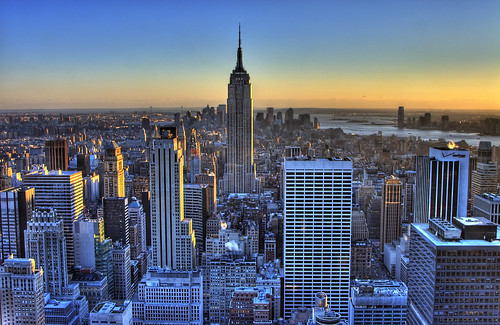
I can't even count the number of windows in this picture and everyone of them is bombarded daily with huge amounts of solar energy. Somebody is about to make a ton of money on these ideas and hopefully the construction sector will start to promote the use of this technology.

More After the Fold...

0 comments:

March 5, 2008

Wind Power!


The World's first residential wind turbine is now available for purchase! The Power Save Wind Turbine is able to produce 2.5 times more power than conventional wind turbines.

Power Save is a company who has offered residential solar panels for a few years now and has jumped into the wind market. It will be interesting to track their sales and see what kind of numbers they can generate in the US. More on the Power Save Wind Turbine.

More After the Fold...

0 comments:

February 29, 2008

Beat of the Nation: Renewable Energy

I have my own views on renewable energy which I will be spouting profusely about in the coming weeks but today I take a back seat as I continue my survey of the American populace and their thoughts on renewable energy.

Disclaimer: Absolutely none of these polls are scientific as I do not control the sampling or the bias of viewers beliefs who participate. But the results are not tampered and I myself do not count the votes as an automated service registers the answer of each unique IP address.

The major issue we will have to tackle no renewable energy is incorporating the technologies into the transportation sector. As long as Americans can plug in their home devices I'm pretty sure they don't care where its coming from, but for some reason Americans are completely absorbed with their love of cars. So the question is which alternative fuel is more likely to succeed? A whopping 60% said Hydrogen will be the fuel of the future with Ethanol and biodiesel garnering 16% and 9% respectively. Other received 15% which shows the uncertainty the public has with all of the available technologies.

When asked if a hybrid vehicle sounds more appealing now than it did 6 months ago
25% said yes it was a better buy now while 65% said no, I am still as pro-Hybrid as before while 9% was just as anti-hybrid as before. So all of these people say they are pro-hybrid and manufacturers are starting to roll out hybrid SUV's to satiate America's bigger and better complex. The question is will they sell? 79% say yes consumer demand is there while 21% said no, it is not worth the added cost.

You next vehicle will get: 36% said 30-40 mpg; 35% said 20-30; and 16% said 40+ mpg.

Just to show how reluctant Americans really are though to change within their vehicles I asked whether they would consider buying a diesel car. 54% said yes while 46% said no. Little do most Americans realize that the rest of the world is running on diesel and that its a much more efficient fuel (check out this blogger who got 72 mpg in a stock Euro diesel Honda Civic).

Now with these numbers I feel like my sample was biased toward the need for hybrid and renewable energy vehicles but the response was so overwhelming you have to think that companies will be forced to improve hybrid efficiency and strive for innovation within their power consumption.

Massive power consumption on the commercial scale where we need to see the biggest push as we adjust from a coal and oil dependent energy grid to alternatives. Here are a few questions on that.

Governors want coal considered as "green" fuel. You say: 24% Coal is a viable option, 76% Coal is too dirty to be considered "green"

Scientists list "greatest engineering challenges." Biggest of these?
41% Making solar energy affordable; 27% Provide energy from fusion; 10% Prevent nuclear terror. Its interesting here that our politicians rail about the need to stop terrorist attacks and the public's mind is much more worried about energy solutions as two categories of energy trumped the nuclear threat.

The public's interest in cutting edge renewable technologies is growing also. When asked whether the Gulf Stream could be harvested for energy production 83% were confident that a suitable technology could be developed while only 17% said it sounds too far fetched.

Here's a touchy one, and one that I am very invested in. Should we build more nuclear plants to aid energy independence? 71% think so while only 29% don't. I think it is a necessary energy source moving further into the 21st century. I would do an analysis of safety but I really don't think it needs to be done, maybe I'll look up how many people died in nuclear accidents this year versus coal miners but I'm sure we don't need to bring that heartache back up.

Here's probably my favorite:


And what are American's doing now to combat energy expenditure? Are you more likely to buy a product that has an energy star logo? 46% said yes, definitely; 31% said maybe; and 23% said no, not really. This one is a big eye opener to me, especially with how much the answers were skewed toward alternative and energy saving fuels in cars. Maybe the gas price hike has caused Americans to rethink their traveling expenses, but soon enough these prices will be felt in the home.

And one loaded question for the respondents which I was really impressed with the answer. Your neighbors install an ugly, energy-generating windmill. You: 64% Congratulate them, its green; 22% Grumble but do nothing; 11% Ask local government to remove it; and 3% Ask them to take it down.

So that's the beat of the nation when it comes to energy saving and renewable energy. Next week I'll have a more detailed look at the different types of energy and their true viability in a commercial market which has to compete with oil and coal.

More After the Fold...

0 comments:

Texas Energy Crisis


Texas again reigns supreme as the leader in CO2 production in the nation! This is just another award that embarrasses me being a native Texan along with our degradation of science principles in high schools (I'll cover this on Saturday) and being some of the fattest Americans. This report though hits on the underlying problem in the state; that our local and state governments are in bed with big industry.

So being a scientist I like to tease out all aspects of the facts in order to get a full picture of the information. I'll steal from a Newsweek article here:

If Texas were its own country, it would be the 48th most populous in the world, right between North Korea and Ghana. In terms of landmass, at 268,000 square miles it would be the 40th-biggest. Were the Lonestar State to secede from the union it would be the world's eighth-largest emitter of the greenhouse gas carbon dioxide, just behind Canada, with 630 million metric tons spewed into the atmosphere in 2005, according to new figures released this week by the U.S. government's Energy Information Administration. That's actually a reduction of 40 million metric tons since 2003, when Texas was the globe's seventh-largest CO2 contributor. But even though the state is improving, Texas still outpaces the combined emissions of California and Pennsylvania, the states with the second- and third-highest CO2 outputs.
Wow! We produce more greenhouse gas than the number 2 and 3 states combined?!?!? Of course Texas is the nation's largest energy producer, and has more cattle and oil refineries than any other state, effectively making us the power plant, gas pump and beef basket of the nation. So is industry totally to blame for this? Hell no, its us the citizens who really need to look at ourselves. Our 23.5 million citizens use 3,000 more kilowatt hours every year than the average American, and we like to drive large gas guzzling cars. According to the Texas DPS there are 20 million vehicles registered in the state, and a full quarter of them are pickup trucks (nationally 16% of vehicles are trucks). And this last year 61% of new vehicles were light trucks (nationally, 47%) .

A third of our emissions come from transportation and in such an expansive state little to nothing has been done by either local or state governments to ease this environmental pressure. As defined by the EPA's Clean Air Act more than half of all Texans live in areas where the air is unsafe to breathe.

And you think this type of health hazard would spur the government to enact change but Texas stands as one of only 15 states without a climate action plan. And of those 15 states 11 have bills under consideration, but Texas has yet to even begin to consider a plan! And here's how serious our governor is about climate change, last year he said "Al Gore's mouth is the country's leading source of carbon dioxide, not Texas." And bless the good Aggie's heart, you know he's just looking out for big business in his state, but at some point Texas is going to have to break the co-dependence on the oil industry for policy and money.

So how is big industry affecting Texans energy policies? Well last year the Texas Association of Manufacturers and Houston-based Exxon Mobil successfully lobbied against a bill that would have provided tax incentives for businesses and homeowners who install solar panels. The state legislature even voted down a bill that would have increased taxes to provide for a light rail system in the state. The Texas Oil and Gas Association and Texas Automobile Dealers Association spent $12 million to successfully defeat a bill by an Austin Democratic senator that would have set up a task force to study climate change. And in 2006 TXU announced it would build 11 coal plants to supplement the 18 Texas already has. The state government even fast tracked the application process to ensure the public had little to no time to comment on it. Luckily a coalition of 40 cities and local governments blocked the plans and TXU was bought out. An upcoming documentary by Robert Redford, "Fighting Goliath: Texas Coal Wars" will detail the fight against big industry.

But things aren't all bad. Texas continued to push wind power and added $3 billion in wind generation last year. Legendary oilman Boone T. Pickens has invested billions of his own money to build the largest wind farm in the world in the Texas panhandle which should begin construction in 2010.

And even though the state government has dropped the ball, local governments are making a push towards renewable energy sources with Austin leading the way. Austin mayor Will Wynn put forth a plan to have the city run 100% on renewable energy sources by 2012, that's only 4 years!!! The plan also calls for every new single-family home to be zero-net-energy-capable by 2015!

The push for innovation in these areas will come from local governments and their citizens who demand that energy production be adjusted to uncuff the state from the oil industry. Big business has little interest in these goals as witnessed by GM Vice Chairman Bob Lutz who during a closed door meeting with journalists in Dallas said, "Global warming is a total crock of shit. I'm a skeptic, not a denier … I’m motivated more by the desire to replace imported oil than by the CO2." Wow, talk about a real desire to help not only our neighbors but our planet.

I for one am planning to make myself less oil dependent in the next 5 years and for many reasons. One will be the cost of oil consumption. Basic economics tells us that as supply decreases (we keep taking out oil, but no new supplies are being created) and demand increases (humans have used 1 trillion barrels of oil since 1859, more than 93% of it since 1973) prices will skyrocket.


I am unwilling to use a vendor who's cost of service has tripled in the last 7 years and has a 62.8% medium or worse risk of delivery failure. I'm unwilling to rely on an industry which can cut off 97% of its supply for political, weather and policy demands.

Ordinary citizens are starting to listen as well. A family friend of ours has recently added 78 wind turbines twice the size of the Statue of Liberty to his farm outside of Sweetwater, TX. He gets paid abou $500 a month for allowing the turbines on his land and his new favorite catch phrase is "that's just money you're hearing." The New York Times even picked up on this story and has made Louis a local celebrity with farmers and city dwellers alike asking how they can get in on some of the money. This is a very telling movement as always has been the case with human reason, if there is incentive your ideals will change to meet the reward.

So go out and make a difference Texans, this is our damn state! Don't let the businesses and suits in Austin tell you how the energy policy should be, be heard and make a stand. Contact your local politicians and tell them how you feel. I myself have had good conversation with Senator Ogden concerning two separate energy bills which the congress will see this year. I encourage all of you to get out and shoot a quick email or phone call to these guys, its their freakin' job to listen!

Senate District 5--Senator Steve Ogden
District Address: 3740 Copperfield Dr., Suite 103
Bryan TX 77802
Phone: (979) 776-0521

House District 14--Representative Fred Brown
District Address: 1920 West Villa Maria Road, Suite 303
Bryan TX 77802
Phone: (979) 822-9797

And our national representatives:

Congressional District 17--Congressman Chet Edwards
111 University Drive East, Ste. 216
College Station, TX 77840
Phone: (979) 691-8797

Senator John Cornyn contact.

Senator Kay Bailey Hutchinson contact.

*All of these Congressman have email addresses on their linked pages. I encourage you to slip a little note that this sort of stuff is important

More After the Fold...

0 comments:

March 1, 2008

McCain Scores Zero, Texas Fails on National Environmental Scorecard

The League of Conservation Voters recently released their 2007 scorecard for Congressional Conservation Voting Records and John McCain scored a zero for the whole year of 2007. In fact, two dead Congressmen scored higher than McCain.

McCain was the only member of Congress to skip every single crucial environmental vote scored by the organization. Wow, really? You claim to be a proponent of the environment and you missed every single vote on conservation last year? Carl Pope, Executive Director of Sierra Club, had this to say.

Every other Member who received a zero from LCV last year at least had the
temerity to show up and vote against the environment and clean energy time after
time. And unlike John McCain, I doubt any of them would claim to be
environmental leaders or champions on global warming.


More importantly for those of us in the Lone Star State is how awful our state fared on the scorecard. In the Senate, John Cornyn and Kay Bailey Hutchison scored 3% on the 15 issue scorecard. Cornyn, along with McCain was joined by 5 others in the Senate with 0%. The House fared just a little better with 30% but 13 of our 32 Representatives scored a 0%. This is pathetic in a state that has so much potential to lead the way in conservation and environmental policy innovation. Texas has a massive intellectual community# per capita, concentrated in 4 of the largest research campuses and biotech industry hubs in the nation. If our leaders could commit to progressive policies we will see the results in 10-15 years, but we need to harness and incubate newly-born technology now! A down payment now will pay off greatly for our future by allowing us first access to commercial products based on renewable energy and energy efficiency. The warning should be for now, every kilowatt is going to keep getting more expensive as long as we rely on a source with limited capacity and a finite reserve!

But I digress, the Texas score highlights a general trend within the parties with Democrats scoring much higher than their Republican counterparts. Democratic Senator leadership scored a 91 while the Republicans scored a 7.

Democratic leaders were Majority Leader Reid (NV, 87%), Durbin (IL, 93%) Majority Whip, and Schumer (NY, 93%) Conference Vice Chair. Republican leaders were McConnell (KY, 7) Minority Leader, Lott (MS, 0%) Minority Whip, and Kyl (AZ, 13%) Conference Secretary.

In the House the numbers are no better for the Republicans as they clock in with an underwhelming 2%. The Democrats scored 87%.

Democratic leaders were Pelosi (CA, NA*) Speaker, Hoyer (MD, 90%) Majority Leader, Clyburn (SC, 80%) Whip, Emanuel (Il, 90%). Republicans were Boehner (OH, 0%) Minority Leader, Blunt (MO, 0%) Minority Whip, Putnam (FL, 5%) Conference Chair.

The Republicans need to stop protecting big industry on these issues (take a look at those links and honestly tell me all of them aren't screwing you). Companies make large amounts of money and sway much of policy, this is unfair for consumers as none of this money can guarantee a healthy future for anyone. Hopefully people will wake up and demand that these type of issues be discussed and dealt with appropriately. The scientific community is screaming for the opportunity to innovate, but the money isn't there.

At the Biotech company I work at there is a strain all year to produce vast quantities of proposals in the hope that a few get picked and can fund enough of the payroll to write more proposals. Whatever pathetic amount is squeezed out of that goes to actual research, stunting the ability to truly unleash our intellectual wealth.

Google has pledged $20 million on solar and wind technology and in a press release said it "anticipates investing hundreds of millions of dollars in breakthrough renewable energy projects which will [sic] generate positive returns." That's pretty frightening guys, think about it. A corporation is going to outpace our government at seed level research and will reap the benefits in the future.

#Subscription required
*The Speaker of the House votes at her discretion

More After the Fold...

0 comments:

September 16, 2008

John McCain Reveals His Jackassery Once Again

John McCain has been in the news quite a bit recently. His comments on the economy are the definition of irony, and the media has finally begun calling a spade a spade, and McCain's campaign press, well, bullshit. Not to mention the Palin soap opera/Law & Order episode.

Little noticed news item, McSame finally answered the ScienceDebate2008 presidential candidate questionnaire. Obama's answers here. On the energy question, McCain made a passing reference to wind, solar, geothermal, tide, and hydroelectric energy potential, without mentioning a serious effort to increase the use of these technologies. Seems like he was primarily concerned with explaining away all those votes he had cast against renewable energy. He mumbles something about "reforming" the tax credits for the industry (in repubspeak: remove all responsible regulation). Just more lip-service, no policy.

Then he rants about nuclear power. He proposes building 45 new reactors by 2030. Thats a lot of nuclear power plants folks. You want one in your backyard? I don't. And he completely whitewashes the reality of this option as well.

Nuclear power is a proven, domestic, zero-emission source of energy and it is time to recommit to advancing our use of nuclear energy.
"Zero-emission?" Yucca Mountain, anyone? Was he even awake when his lobbyists/advisers were writing this tripe?

Under the previous topic "Climate Change," he plugged for 30 billion dollars over the next 15 years for the freakin' coal industry. "Clean coal" is still coal, my friend, euphamisims wont change the fact. Filtered cigarretes will still kill you. And really? I'm no econimist, but $30 billion seems like a lot for an industry we should be moving away from anyway.

Read his other answers at your own peril.

More After the Fold...

0 comments:

March 10, 2008

NBC11 Hits a Homerun With Wind Power

In San Jose, California a big thing happened on Friday. NBC11 became the first TV station to be fully powered by wind. To be factually correct the TV station has begun to buy as many wing power energy credits as they produce so that all of their power consumption is set off by wind energy production. The energy tax credits and public-friendly appeal were too much for the station to pass up and when the pitch came they took a swing.

This is part of an effort by the station called "EcoLogic" that aims to "educate NBC11 employees, viewers and local businesses about ways they can reduce their carbon footprint at work and at home." The campaign kicked off in January when the station educated and informed employees to turn off lights and computer stations when not necessary. After two months of saved energy costs the company bought enough Renewable energy certificates to offset the energy costs of their San Jose studio and invest in wind energy research.

In all honesty I'm not a huge fan of the buying clean energy credits. I applaud the effort to fund renewable energy and have it contribute to the energy grid but I feel it removes a crucial element to true investment in renewable energy. The company really has no incentive to reduce their energy usage as they can just buy off however much energy they use. True, a company will have to spend more if they decide to be wasteful and that extra money will go towards research but companies have no real investment in the programs.

At anytime a company could decide to stop with the credit buying and fund something else. But if the company truly relied on its energy from a solar or wind plant you better believe that they would make sure the thing is running and reliable. That is a true investment in technology, one where your operation simultaneously uses and nurtures a process in the hopes of future gains. As it stands these companies have little incentive to baby their partners as there are multiple vendors of energy credits and if your vendor shuts down a quick shop will solve the problem.

This shouldn't take away from what NBC11 is doing because at their heart the company is truly making an effort to reduce their impact and influence those around them to do the same. Hopefully more of corporate America will step up to the plate and at least take a swing, we've watched the pitch go by us for too long.

More After the Fold...

1 comments: