Showing posts with label conservation. Show all posts

May 22, 2008

Ready To Throw Out Your Refrigerator?

Came across an interesting fact today that may make you change your mind about whether you can really afford to buy new Energy Star rated appliances.

Refrigerators qualified under the new Energy Star guidelines use less energy than a 75-watt light bulb left on full time. That's a lot of energy savings, $92 million a year if everyone in America who buys a fridge in 2008 buys an Energy Star model.

More After the Fold...

0 comments:

April 14, 2008

Nature is Not a Liberal Plot

"Our nation's continued prosperity hinges on our ability to solve environmental problems and sustain the natural resources on which we all depend."

Any guesses as to who said that? It might shock you that it is John McCain, especially after he scored 0 on the National Environmental Scorecard for 2007. That quote was taken from a November 22, 1996 article in the New York Times written by John McCain himself.

This is just another example of how the brazen, do-good-at-all-cost senator from 10 years ago has shifted his tune and fallen in line with the Republican party.
"Have Republicans abandoned their roots as the party of Theodore Roosevelt, who maintained that government's most important task, with the exception of national security, is to leave posterity a land in better condition than they received it?"

That's a good question John and it seems like you've answered it with your voting record. Yes, your party has abandoned the idea of conservation in favor of a personally-profitable marriage with big industry. Your party's attempts to repeal the Clean Air Act as well as pumping billions of dollars in tax rebates and government contracts has left the Grand Ole Party in a precarious position.
"I recognize the right and duty of this generation to develop and use our natural resources, but I do not recognize the right to waste them, or to rob by wasteful use, the generations that come after us." -Theodore Roosevelt

This is what your party stood for before you forged an alliance with the oil and coal industries. The idea that a man could till the land for prosperity and leave it to his sons has degraded into the idea that as long as money is flowing and a select few are able to amass personal wealth (legally or illegally) the country is healthy.

Unfortunately that is not the case. The economy may be faltering now but it will correct itself and there will be money to be made, the mechanisms of global economics assures that. But the land that we are ruining now will not correct itself under huge physical pressures that we are forcing upon it. Conservation has been thrown to the wayside, along with all of the other McCain ideals that he espoused so profusely in the past. Get ready for 4 more years of the same crap if this guy gets in office, its pretty obvious that he will do whatever it takes to appease his party and looking at the state of our nation I say that is a scary prospect.

More After the Fold...

0 comments:

March 19, 2008

RecycleBank raises $30M

The most low-tech of clean technologies, recycling, got a boost today. RecycleBank, a Philadelphia-based startup that runs incentive-based recycling programs, has raised $30 million in Series B funding led by the high-profile VCs at Kleiner Perkins, PEHub reports. RecycleBank’s round also included existing investors RRE Ventures and Sigma Partners, who together invested $13.1 million in a Series A financing last year.


RecycleBank seeks to revitalize municipal recycling by incentivizing the program for consumers. The more a customer recycles, the more “RecycleBank Dollars” he or she earns, which can be redeemed for discounts at over 250 different businesses. So by recycling more beer bottles, newspapers and shampoo bottles you can get discounts on Jockey underwear, Starbucks lattés or even PetCo dog food.

The way it works is your recycling container contains a unique RFID in which you can recycle glass, plastic, metal, paper and cardboard. The recycling trucks identify each container and weigh the contents, crediting the household. Customers can track and manage their recycling and rewards through RecycleBank’s web site.

Making the recycling business a profitable one is a tall order. Amid a budget crisis in 2002, New York City stopped recycling glass and plastic altogether because the program was losing too much money (the Big Apple has since resumed recycling). But RecycleBank is all too aware of what a volatile market it can be; it points to the most recent Annual Nationwide Survey of Solid Waste Management in the U.S., which notes that 28 states have seen recycling rates go down since 2001.

RecycleBank makes its money from the municipalities themselves, who pay based on number of household involved. The company also gets a cut from the recyclers, assuming they see a boost in materials coming in.

Early pilot programs turned in some impressive recycling adoption rates. In two Philadelphia communities RecycleBank boosted recycling rates to 90 percent each, up from 35 and 7 percent, respectively.

Now the only real problem I see with this sort of business plan is theft. And to tell you the truth if theft of recycling bins, or midnight runs to steal your neighbors recyclables, is the problem then it means the system is working. I know that my house has started recycling and not many other people really do. I have been by myself many times in the parking lot of Wal Mart sorting through my different recyclables. This is only a good thing, and by the early numbers it really was an incentive that people will get behind and support.

More After the Fold...

0 comments:

March 17, 2008

Update: Water Everywhere, and Not a Drop to Drink

Last week I put together a report on the worlds water situation here. This week even more news concerning water shortages as Egypt reports that 6% of their population goes without clean drinking water daily. And new reports shows sewage coming through the water pipes as poor care has been taken with their water delivery infrastructure.

More After the Fold...

0 comments:

March 14, 2008

Water Water Everywhere, And Not A Drop To Drink


Everyday I wade through hundreds of news articles about the harm we are causing through carbon emissions and unregulated pollution. Companies are racing to find a way to scrub power plants, create low emissions vehicles, and develop home-use green products. While these are all very necessary and progressive ideas, one area of conservation gets little attention, and it may be the one resource we need to protect the most; safe, clean drinking water. Of all the water on Earth only 0.7672% makes up the total pool from which we can take our drinking water. That's only 2,548,339 cubic miles of water (which sounds like a big number but it isn't)!

The small sphere on the left represents ALL water found on planet Earth. Now imagine taking less than 1% from that sphere and that is all the water that is available for drinking (and we can't create water so this is a fixed number).


So are we really in that much trouble? I know when I turn my faucet on water will continue to flow indefinitely until I turn it off. If there was such a shortage surely the government would restrict my water usage, right?

Unfortunately no, the government has done little to mitigate our dwindling water supplies and doesn't look to be doing anything about it in the future. Large factories are dumping megatonnes of pollution a year into our rivers and lakes and it is starting to take a toll. Just this week reports about hormone and drug levels in public drinking water have raised the alarm to our water quality. Fish, a great biomarker for effects of water pollution, are now being born hermaphrodites in our polluted rivers and lakes. We are all concerned about genetic manipulation in the lab, but look out in nature and we are doing much worse. All of the intersexed fish have been traced back to pollution from our industry byproducts.

And pollution isn't the only problem in our water, we just plain aren't conserving enough. Atlanta may run dry in the next 10 years and other nations around the world are beginning to struggle as well. Ghana is struggling with not only a water shortage, but also with pollution in the few safe drinking reservoirs the country has. The government has taken some blame but has also rightly put the responsibility to conserve back on the citizens.

China recently doubled its drinking water shortage statistics from 2.43 million to 5.9 million people who do not have access to clean drinking water. From Feb 23 to 28 the number of livestock without sufficient drinking water jumped from 1.89 million to 5.67 million. These are unbelievably high numbers and only highlight the growing worldwide trend.

Pakistan's hydroelectric reservoirs are drying up and several are running at "dead level". Expanding nuclear power seems to be the only solution for Pakistan at this late stage.

On a brighter note, North Carolina Governor Mike Easley has started a three-pronged attack to alleviate water shortages and pollution problems in his state. He says "North Carolinians should understand that the days when water could be used without an eye on the meter and without repercussions for wasting it are over."

Maybe I just worry too much about the water supply (to Czechs water pollution is the biggest issue, go motherland!, but that fact is that we are running out of clean water and soon we may have to turn to the ocean to provide us with clean water. The Netherlands have already started to experiment with getting clean water from the ocean by using some innovative windmill technology. This is all fine, but pollution reduction and conservation must work hand in hand if we are to have clean, CHEAP drinking water for decades to come.

More After the Fold...

0 comments:

March 11, 2008

CO2 Saver: Easy Way to Green Your PC

Paul from Snap just sent me this link and its a great way to save energy on your home computer without doing anything! CO2 Saver is a lightweight program that manages your computer's power usage when it's idle, saving energy and decreasing the demand on your power utility.

The less electricity produced, the fewer harmful emissions and greenhouse gases such as carbon dioxide (CO2) are released into the atmosphere.

Extra cool feature is that is shows you how much you save every month versus if your PC had been running with CO2 Saver.

More After the Fold...

0 comments:

March 1, 2008

McCain Scores Zero, Texas Fails on National Environmental Scorecard

The League of Conservation Voters recently released their 2007 scorecard for Congressional Conservation Voting Records and John McCain scored a zero for the whole year of 2007. In fact, two dead Congressmen scored higher than McCain.

McCain was the only member of Congress to skip every single crucial environmental vote scored by the organization. Wow, really? You claim to be a proponent of the environment and you missed every single vote on conservation last year? Carl Pope, Executive Director of Sierra Club, had this to say.

Every other Member who received a zero from LCV last year at least had the
temerity to show up and vote against the environment and clean energy time after
time. And unlike John McCain, I doubt any of them would claim to be
environmental leaders or champions on global warming.


More importantly for those of us in the Lone Star State is how awful our state fared on the scorecard. In the Senate, John Cornyn and Kay Bailey Hutchison scored 3% on the 15 issue scorecard. Cornyn, along with McCain was joined by 5 others in the Senate with 0%. The House fared just a little better with 30% but 13 of our 32 Representatives scored a 0%. This is pathetic in a state that has so much potential to lead the way in conservation and environmental policy innovation. Texas has a massive intellectual community# per capita, concentrated in 4 of the largest research campuses and biotech industry hubs in the nation. If our leaders could commit to progressive policies we will see the results in 10-15 years, but we need to harness and incubate newly-born technology now! A down payment now will pay off greatly for our future by allowing us first access to commercial products based on renewable energy and energy efficiency. The warning should be for now, every kilowatt is going to keep getting more expensive as long as we rely on a source with limited capacity and a finite reserve!

But I digress, the Texas score highlights a general trend within the parties with Democrats scoring much higher than their Republican counterparts. Democratic Senator leadership scored a 91 while the Republicans scored a 7.

Democratic leaders were Majority Leader Reid (NV, 87%), Durbin (IL, 93%) Majority Whip, and Schumer (NY, 93%) Conference Vice Chair. Republican leaders were McConnell (KY, 7) Minority Leader, Lott (MS, 0%) Minority Whip, and Kyl (AZ, 13%) Conference Secretary.

In the House the numbers are no better for the Republicans as they clock in with an underwhelming 2%. The Democrats scored 87%.

Democratic leaders were Pelosi (CA, NA*) Speaker, Hoyer (MD, 90%) Majority Leader, Clyburn (SC, 80%) Whip, Emanuel (Il, 90%). Republicans were Boehner (OH, 0%) Minority Leader, Blunt (MO, 0%) Minority Whip, Putnam (FL, 5%) Conference Chair.

The Republicans need to stop protecting big industry on these issues (take a look at those links and honestly tell me all of them aren't screwing you). Companies make large amounts of money and sway much of policy, this is unfair for consumers as none of this money can guarantee a healthy future for anyone. Hopefully people will wake up and demand that these type of issues be discussed and dealt with appropriately. The scientific community is screaming for the opportunity to innovate, but the money isn't there.

At the Biotech company I work at there is a strain all year to produce vast quantities of proposals in the hope that a few get picked and can fund enough of the payroll to write more proposals. Whatever pathetic amount is squeezed out of that goes to actual research, stunting the ability to truly unleash our intellectual wealth.

Google has pledged $20 million on solar and wind technology and in a press release said it "anticipates investing hundreds of millions of dollars in breakthrough renewable energy projects which will [sic] generate positive returns." That's pretty frightening guys, think about it. A corporation is going to outpace our government at seed level research and will reap the benefits in the future.

#Subscription required
*The Speaker of the House votes at her discretion

More After the Fold...

0 comments:

February 21, 2008

To the Victor goes the Spoils

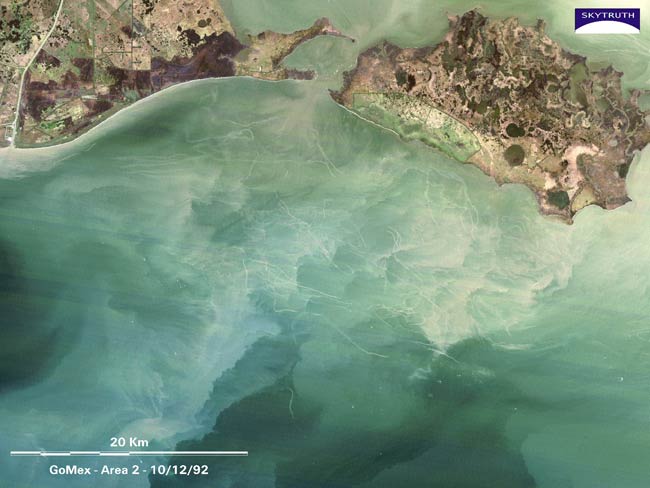
(click for larger image)

Technology is increasing available to the layperson and Landsat images give a good account of what's happening in our oceans, and sadly most of it is not good. The image above is of the Gulf of Mexico in 1992. The cloudy water that you see is the direct result of commercial bottom trawlers dragging large, heavy nets across the seafloor, denuding it of all life in their quest for a few marketable fish and shrimps. Most trawling efforts capture 20 pounds of "bycatch" in the search for commercially viable fish, and in their wake leave large, suffocating clouds of mud and sediment that may take a month to settle.

Recently the impact of bottom trawling has been seen with services like Google Earth providing large amounts of Landsat images in a public forum. John Amos, president of SkyTruth in Sheperdstown, West Virginia states: "Until recently, the impact was basically hidden from view," he continued. "But new tools -- especially Internet-based image sites, like Google Earth -- allow everyone to see for themselves what's happening. In shallow waters with muddy bottoms, trawlers leave long, persistent trails of sediment in their wake."

The bigger problem is that most bottom trawling is done in deep open waters where damage to the sediment layer is invisible to satellite imaging. "Most .. trawling happens in deep waters, out of sight. But now we can more clearly envision what trawling impacts down there by looking at the sediment plumes that are shallow enough for us to see from satellites," said Les Watling, professor of zoology at the University of Hawaii-Manoa.

Sponges, corals, and other light dependent organisms fail to survive week long periods in the darkness and this in turn knocks out the habitat and food supply of most commercially available fish.

So what can you do to help reduce this environmental destruction? Until the industrial fishing industry proves that they are acting in a more environmentally responsible manner, you can boycott eating orange roughy, Chilean sea bass (Patagonian toothfish), and all shrimps. (Keep in mind that those shrimp species that are not caught by trawling are usually farmed in shallow coastal mangroves, which also leads to tremendous, and possibly irreversible, environmental damages).

Fortunately politics are starting to listen to the scientific community and in 2005 restrictions on bottom trawling were levied in the Mediterranean Sea and in shallow water areas off the coast of Alaska. In 2006, the South Pacific Island Nations voted to stop bottom trawling in their waters, which accounts for 14% of Earth's total surface. The UN will meet later this year to decide whether to place a moratorium on the high seas, which covers 45% of Earth's surface. Lets hope they listen to the people who monitor Earth's vitals.

More After the Fold...

0 comments:
