
Drinking water, its something so inconspicuous that most of us take it for granted. If you think about it, there's nothing stopping you from turning on every faucet in your house and leaving them on while you go to work (besides the cost). Our ease of access to clean, public drinking water has diminished our concern for the quality of water as well as the planning and management of future water use.
Of utmost importance to those studying our water supply is the protection from point source and non-point source pollution and contamination. Every year we are dumping more and more hazardous or foreign materials into the water table and open reservoir system. This does not bode well for our future and here's why.
Water, just like oil, has a finite supply. There is the same amount of water on Earth now as when it was formed (you may drink water the Neanderthals drank). Freshwater, safe for drinking, has a much smaller supply. Of all water on the Earth 0.76% can be found as fresh groundwater, 0.007% is found as freshwater lakes, and 0.0002% is found in rivers. So our total pool for drinking water is only 0.7672% of all water found on Earth. That's only 2,548,339 cubic miles of water! And this supply is only getting smaller as it takes about 100 years for a water molecule to get from the ocean to a freshwater source. In the US we have 25 states under drought conditions, with 9 suffering from extreme to exceptional drought. Atlanta is going to have their wakeup call before anyone else as its been predicted their reservoir system will be drained in 10 years if rainfall doesn't increase or a more progressive management system isn't utilized.
So yeah the supply of drinking water is a small percentage of total water on the Earth, but who cares? Well I do for one, and here's a few reasons why.
Rocky Mountain National Park reports trout in 5 lakes have both male and female sex organs. These fish have never had a sex determination naturally that ended in hermaphrodites and the cause of this has been pinned on pollution in the water altering endocrine function in the fish. Fish are great biomarkers for the health of water reservoirs because they are constantly exposed to all contaminants and are an early warning sign of what water can do to us.
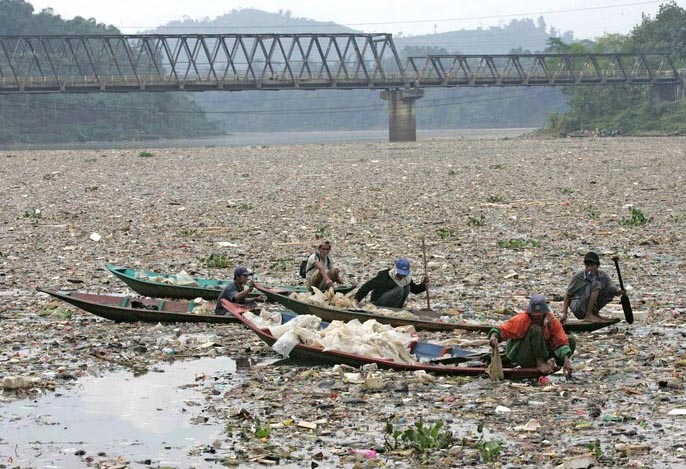
China recently has had great problems as it becomes industrialized as large plants are dumping toxic chemicals into their river systems (see photo above). Government oversight has been slow to respond to the threats and many people have lost access to public drinking water. In fact, China has 2 of the top 10 polluted places on Earth. Around Tianying the birth defect rate is so high that it passes stroke as the leading cause of morbidity and mortality. Just last month over 60,000 Chinese citizens had to rely on bottled water for their needs due to a massive runoff of a coal plant. And this isn't the first time this has happened in China, in November 2005 a spill of cancer-causing chemicals, including benzene, forced the government to cut off drinking water to 3.8 million people for 5 days.
Another aspect of all of this dumping is that all of the waterways in the world are connected. Throughout the water cycle a molecule will travel from ocean to precipitation to groundwater to rivers, and the cycle has no concern for national or international borders. Russia has had to deal with 3 large chemical spills in China that were washed into Russian territory by rainfall and river runoff.
But what about Texas?
 The red areas of this map indicate polluted waters in Texas. It comes out to about 30% of surface water which is contaminated by some sort of pollutant. This could be bacterial blooms, toxins, heavy metals, or plastic based by-products. We need to stand up and protect our waterways before we are in a situation like Georgia.
Texas leads the nation in the number of treatment plants and industrial facilities that fail to meet pollution standards for the wastewater they dump into rivers and streams.
A report by US Pirg, Troubled Waters, found that 318, or about 53 percent, of the state's major industrial and wastewater plants failed Clean Water Act standards in at least one of 12 reporting periods in 2005.
A 2003 state auditor's report that looked at 80 pollution cases backs that contention. The auditor found that state fines for the pollution cases totaled less than $1.7 million, but the facilities involved benefited more than $8.6 million by not complying with regulations.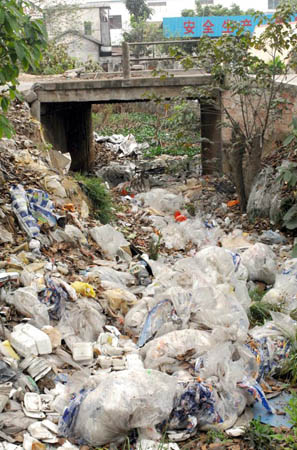
And the problem isn't always industry. Check out this waterway in China meant to runoff to the local treatment plant. After a good rain everything in the trash leaches back into the water supply and continues to build to a toxic level. Over time this will effect the microflora and fauna which is the backbone to a healthy pond or stream environment. Without those primary producers and the oxygen their photosynthesis produces there is no way to sustain a large tissued animal.
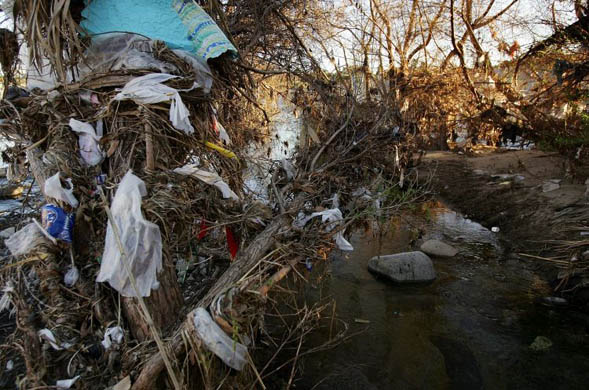
And the problem isn't confined to the up-and-comers of the world. Right here in the US you can see scenes like this in Los Angeles. We need to wake up people and see what we're doing to the environment.
More After the Fold...
Summary only...





 Posts
Posts


0 comments:
Post a Comment