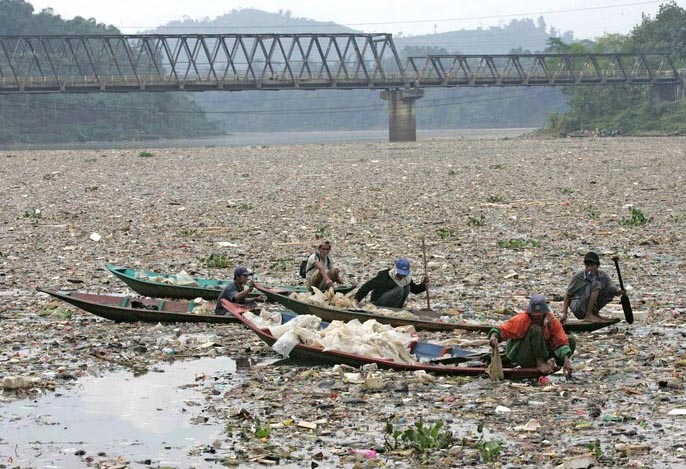
Sometimes I feel like no matter how much text I spew out about climate change and damage to the environment I just can't get the point across that we really are affecting our planet. So I've gathered a few visuals to do the explaining, you can't argue with this.
More After the Fold...
Summary only...
Hokkaido, Japan was the setting for a rather unusual exchange between world leaders. As the G8's meetings on climate change and policy were wrapping up George Bush decided he would say "goodbye from the world's biggest polluter" and then pump his fist in the air and smile.
The rest of those in the room sat in silence, shocked that they had just heard that statement on the back of the most important climate talks between nations. And that is a hard thing to do, most of the people in the room were world leaders who have made a career out of speaking their mind. And maybe they were stunned because it wasn't so off-the-wall that he would say something like that.
As The Independent put it, the "remarks were taken as a two-fingered salute from the President from Texas who is wedded to the oil industry. He had given some ground at the summit by saying he would "seriously consider" a 50 per cent cut in carbon emissions by 2050."
Bush's comment was most likely an attempt at humor after a few grueling days of talks, but I think it speaks volumes about the administration's views towards environmental protection, conservation, and securing the best basis for economic growth in the future. If this was a meeting of the Coalition for Life or MADD I doubt Bushie would've injected levity about those U.S.'s transgressions, but the health of our planet and finding ways to manage it is not out of the realm of sarcasm.
To make the situation more disturbing, Bush probably has the best chance to secure an emissions and trade deal before the new President comes in. Although the Democrats can install a President who will take a more proactive and aggressive stance on environmental issues, pressure to protect American farmers during the election campaign will make it hard to secure a deal after a new U.S. President is in office in January. This fully places the issue of our nation's environmental health (which I stress includes our health, think: rivers, air, soil and crop contamination, ocean pollution, etc) in the hands of someone who has shown little respect, and even contempt, for the environmental pressures we are placing on the planet.
I feel like Bush has check out though and is coasting these last 6 months, he has had a lot of pressure on him and even the record number of vacation days couldn't keep him fresh and interested in issues that will affect his population (that he will leave to his mistake while he sips mojitos and looks for the next business venture he'll run into the ground) and its children.
More After the Fold...
Summary only...
The John McSame campaign continued its march of ignorance this week with a deeply insightful diatribe about climate and national policy. In an interview with E&E News (sub. req'd) the campaign tossed out some info that should really make you question whether the Senator from Arizona could successfully take on the threat of global warming and climate change.
Douglas Holtz-Eakin, a McCain campaign policy adviser, dropped a few incredibly stupid ideas on the American public, I don't know which one is worse.
1. "The basic idea is if you go with a cap and trade and do it right with appropriate implementation, you don't need technology-specific and sectoral policies that are on the books and that others are proposing
simultaneously."
Unfortunately Holtz-Eakin is wrong, and without an aggressive technology development/deployment effort (especially in the transportation sector), a cap & trade system will fail because of the economic strain it will place on America. And what about the explicit statement that McCain opposes "technology-specific and sectoral policies that are on the books" if we have a cap & trade?
How many people who truly care about climate change, other than Sen. McCain, think we are truly pushing clean technologies and transportation too hard? We already know that he doesn't support renewable technology tax credits that have been on the books for years, far before we had a cap & trade policy. This is an especially jaw-dropping statement given that even the delayers themselves have been saying we need a bigger clean tech push for years.
2. Holtz-Eakin called into question the Democratic candidates calls for a new federal low carbon fuel limit, stronger fuel economy standards and policies to reduce US oil consumption. Cap & trade was spouted as the ideal solution by itself and when asked whether McCain would block new corporate average fuel economy requirements that Bush signed into law last December, Holtz-Eakin said, "He's not proposing to eliminate those. He simply wants to check as time goes on if they become completely irrelevant. You might want to take them off the books [!!!], but we're not there yet." (emphasis mine)
In the Energy Information Administration's own analysis of using a cap & trade system to reduce emissions, a good economic model of McCain's strategy because it doesn't capture technology deployment strategies or fuel economy standards, the price of carbon hits a politically impossible level, $348 per metric ton, which, in the EIA analysis, doubles the price for electricity.
3. "You don't need redundant policies that interfere with the flexibility that is the key to meeting these desirable goals at low costs," Beyond a cap & trade "he wants to see the use of nukes. The ultimate policy proposal will be designed to make sure that's true."
The hypocrisy blows my mind. I'll keep it short but taking out "redundant policies" that push clean energy while ramming a very expensive nuclear technology down our throats? A nonpartisan Keystone report "Nuclear Power Joint Fact-Finding" (June 2007) found nuclear "power isn't cheap: 8.3 to 11.1 cents per kilo-watt hour." And as a study by Cambridge Energy Research Associates (CERA) found, nuclear power plant costs have soared in the last couple of years. And, of course, nuclear power has a major supply bottleneck, that will inevitably drive up costs for any country that wants to rapidly accelerate the construction of nuclear power plants.
Those are the facts, and unfortunately it has been proven time and again that the McCain campaign is unconcerned with the facts (sounds a little too much like Bush for my liking). From creationism, vaccination, economic policy, hell damn near everything, the guy refuses to sit down and look at the observed evidence and facts surrounding issues. This scares the shit out of me as I'll be paying for a mistake we made concerning facts in Iraq for the rest of my life. I don't want to go down that same road and I'm afraid that's all McCain offers.
More After the Fold...
Summary only...

Are you a global warming doomsdayer or skeptical that climate change even exists? If so then join BudBurst and help scientists continue to study our Earth and how its changing. Participants volunteer to look out for first bud bursts, first leafing, first flower, and seed or fruit dispersal in their area. Those are all phenological events, meaning biological phenomena that are sensitive to climate variations.
From Project BudBurst:
Phenology is the study of the timing of life cycle events in plants and animals. In other words, studying the environment to figure out how animals know when it is time to hibernate, and what ‘calendar’ or ‘clock’ plants use to begin flowering, leafing or reproducing.
Phenology is literally “the science of appearance.” Scientists who study phenology – phenologists -- are interested in the timing of specific biological events (such as flowering, migration, and reproduction) in relation to changes in season and climate. Seasonal and climatic changes are some of the non-living or abiotic components of the environment that impact the living or biotic components. Seasonal changes can include variations in day length, temperature, and rain or snowfall. In short, phenologists attempt to learn more about the abiotic factors that plants and animals respond to...
Phenological observations have been used for centuries by farmers to maximize crop production, nature-lovers to anticipate optimal wildflower viewing conditions, and by almost all of us to prepare for seasonal allergies. Today, this well established science is also used by scientists to track the effect of global warming and climate change on organisms and to make predictions about the future health of the environment. By tracking changes in the timing of these phenological events, scientists are able to better understand how our environment is changing.
More After the Fold...
Summary only...





 Posts
Posts


0 comments:
Post a Comment