March 25, 2008

Uber Fail by the Anti-Vaccinationists


I was searching around for some flu information at work dealing with an NIH project I have and my google search turned up some pretty freakin scary results. One of the first hits, "Building a Child's Immunity the Natural Way" is so fundamentally wrong about all matters medical that it took a while for me to read through it. It starts off really bad.

New Jersey's Public Health Council gave its citizens a Christmas present that will not please the health-conscious, as it became the first state in the nation to require flu shots for preschoolers.

So being "health-conscious" now means your are anti-mandatory vaccinations. What the fu...
Vaccines are dangerous for the health of any individual, but when administered to small children in their important developmental years, they are especially damaging. Medical "experts" have not even determined the correct dosages for small children, who in this regard are not just small adults. When we talk about daycare, we are talking about babies as young as a few months of age. Additionally, not only do vaccines usually contain mercury, but many lack effectiveness and can cause problems with the development of the child's natural immune system (emphasis mine).

Look, I'm not going to address all of the anti-vaccination canards present in this piece, other than refer you to other excellent sources. Two things really get me though: lies, and this "immunity" thing.

Even if the evidence of a relationship between vaccine use and autism is disregarded, there are more debilitating results of vaccine administration to children. Due to the availability of new health information, a growing number of scientists and doctors have realized the problems revealed by recent immunology research and have begun to challenge the foundational tenets of vaccination. Because it seems that vaccines have eradicated many diseases in the last 100 years, many doctors have been reticent to question them. Such claims have mainly been based on epidemic studies rather than on clinical evidence.

For example, Europe never used the polio vaccines, yet it experienced the same rise and fall of polio cases as did the U.S.

That, my dear reader, is a lie. OK, if you are being generous, it is just ignorance, but I find it hard to be generous, given a 3 second stop at google will take you over to the World Health Organization and explain its polio eradication campaign in Europe. After a lie like that, it's hard to believe anything that follows.
Also, many diseases that were believed to be wiped out have re-appeared under different names. As an example, spinal meningitis and polio have almost the same exact symptoms. There have never been any studies that proved the vaccines actually did cause the eradication of any disease; it has only been assumed by the fact that that the epidemics seemed to have ceased. The CDC uses the concept that a relationship does not prove causality to downplay the autism-thimerosal link, yet ironically, they don't apply the same standard to the relationship between vaccination usage and the end of an epidemic.

That isn't just "moving the goalposts"; that's digging them up, burning them, and scattering the ashes. We all know epidemiologic studies have their limitations, but it's pretty clear to the scientific community, beyond a reasonable doubt, that vaccines successfully prevent disease. (By the way, "spinal meningitis" and polio are completely unalike, and, believe it or not, we actually have tests to tell us what organism is causing an infection. Welcome to the early 20th century!)
All vaccines depress our immune functions. The chemicals in the vaccines depress our immune system; the virus present depresses immune function; and the foreign DNA/RNA from animal tissues depresses immunity. Studies have found that some metabolic functions were significantly reduced after vaccinations were given and did not return to normal for months. Other indicators of immune system depression included reduced lymphocyte viability, neutrophil hyper-segmentation, and a reduced white cell count. So we are trading a small immune depression for immunity to one disease, our only defense against all known disease for a temporary immunity against one disease, usually an innocuous childhood disease. Vaccines have been linked to AIDS and other immunodeficient disorders as well. The trade-off is not at all fair and not worth the risk.

Wow. This is so damned stupid. And dangerous. First, what does this phrase "immune depression" mean? I don't know. They do give a hint futher down, throwing around big words like "neutrophil hypersegmentation" but that's pretty meaningless as an observation, and without references is completely useless. Then the nice scare tactic of vaccines and AIDS. Nice. Really nice. OK, time to explain how vaccines actually work.
Vaccines and the Immune System

This is really cool...much cooler than the cultists would like you to believe. It is teh uber-kool. And please forgive the over-simplification.

We need an example: let's take polio vaccine---you know, the one they never used in Europe when the WHO wiped out polio in Europe. We have two choices, but the one we use the most in N.A. and Europe is the inactivated polio vaccine (IPV). Both of the polio vaccines have advantages and disadvantages, but hey, I only have so much time.

To make IPV, polio viruses are grown in the lab, then "inactivated" with a chemical. This renders them non-infectious. Then they are injected under the skin, which is where the fun starts...

When the inactivated viruses enter the tissues, immune cells patrolling the area detect foreign chemicals, usually proteins. (Viruses are not living organisms, but basically little bits of RNA or DNA and protein.) These cells engulf the invading viruses, process the parts, and actually display them on their surface, like a sign. Other cells (T-cells) come by, and if any of them happens to be able to read this sign, they get very excited. These cells, by various mechanisms, pass the news of the specific invader on to B-cells, which then mature and start making antibodies that are specific to the polio virus. This takes a few weeks. After this initial introduction of polio to the immune system, the antibody reaction dies down, and a few of these now-polio-specific B-cells go into hibernation in the spleen, lymph nodes, gut, and other nooks and crannies.

Let's fast forward a few years. You are about to go on your dream vacation to Uganda. You've been warned about sporatic cases of polio in the area. You have every intention of avoiding unpurified water and uncooked foods, but nobody's perfect. One night at dinner you accidentally eat the salad. They guy who made the salad just returned from the outhouse, which doesn't have a sink. Eww. In his stool were some polioviruses. These were deposited on his hands, then into your salad, and ultimately into your gut. I hope it was a good salad.

When the virus reaches the gut, it latches onto the intestine. Some of your immune cells recognize it, and start the same process that happened when you were vaccinated. Except you have those clever little "memory B-cells" left over from your vaccination, so instead of the immune reaction taking weeks to ramp up, it takes hours. Your B-cells start dividing and producing antibodies and secreting various important chemicals. The antibodies mark cells infected with polio with a big sign that says "kill me", and the soldiers of the immune system march in and do just that.

If it weren't for your vaccine, the antibody response would have taken too long, and you would have become infected. Chances are you would get lucky and suffer nothing worse than a "stomach flu". Or you could end up paralyzed.

So, when I read idiotic trash like the above article, I get really, really mad. All these years of science, medicine, and public health pumped into the sewer in favor of cult medicine bullshit. They should be ashamed. But of course, they have no shame.

More After the Fold...

0 comments:

March 24, 2008

Miseducation of America

Wow, I almost threw up watching this. Unfortunate really that a bright group of kids is going to have to deal with some issues about this later in life because their parents want confirmation of their own beliefs.

And I really have no problem with religion, I actually attended Easter Mass yesterday (maybe one of the all-time peruasive arguments by a girl) but I believe an understanding of science and religion is not mutually exclusive. And how do I know that teeth evolved from scales you ask? How do I know? Well...

"It has been contended that Reif's odontode regulation theory is a rival and alternative to Stensio and Orvig's lepidomorial theory as means of explaining the evolution of development of the vertebrate dermal and oral skeleton. The lepidomorial theory is a pattern-based theory that provides a homological framework that goes further than the odontode regulation theory in comparing dental papillae and their products, and it provides an explanatory mechanism for such relationships a posteriori. In contrast, the odontode regulation theory is process-based and observes only developmental similarity providing no means of identifying homologies beyond this. The lepidomorial theory is superior to the odontode regulation theory in its ability to trace homology through the evolution of development of the dermal and oral skeleton. The criteria proposed to identify homology between scales-either within a given individual or taxon, or between different individuals or taxa-are, primarily, vascular architecture and, secondarily, external morphology. External morphology may be excluded on Reif's argument for the overarching principle of differentiation, a hypothesis supported by recent advances in the understanding of dental morphogenesis. Vascular architecture is potentially useful but appears to be determined by tooth/scale morphology rather than reflecting historical (phylogenetic) constraint. Data on the development of epithelial appendages, including teeth, scales, and feathers, indicate that individual primordia develop through progressive differentiation of originally larger, homogenous morphogenetic fields. Thus, there is no mechanism of ontogenetic developmental concrescence, just differentiation." Read the full article here (has some great references).

If that doesn't scream empirical evidence and rational deduction based on a body of data then I don't know what does. And when it comes down to it, that is science, the collection of empirical evidence. A lot of theories get thrown out and many get shot down, but over time the data from experiments doesn't change and eventually a theory encompassing the whole of the body of data will arise to explain the underlying mechanisms.

Pay careful attention to what the curator of the museum says at about the 5:20 mark. "Without evolution the whole of biology does not make sense." That seems like a pretty bold statement, but one that you will find little argument with in any biology professor's office or research lab. Evolution is the framework for every life science there is, it is inescapable regardless of your religious views. Your physician, pharmacist, psychiatrist, hell even your landscaper all rely on evolutionary theory to drive their understanding of their craft. Here's one example for the stupid emails I'm gonna get saying "show me one example." Ok, methyllin resistance Staphylococcus aureus (MRSA) is about to surpass AIDS as the number one killer around the world because it has EVOLVED the ability to resist almost all antibiotics we use. God did not create this bacteria and it did not exist 100 years ago, and we can show you from where it evolved. And in the future we're going to have to learn a whole hell of a lot more about its evolutionary tacticts to defeat it.

More After the Fold...

0 comments:

So I Bitch About Water All The Time


But maybe a picture is worth more than all of my words. Special thanks to Philippe Rekacewicz for putting this together with data from the WHO and UNICEF.

More After the Fold...

0 comments:

March 21, 2008

Can We Please Stop?

Seriously. There is so mush fussing going on now in the media about the words and phrases Obama has used in his attempt to elevate the discussion of race in our nation. After Obama's historical speech this week, the commentators and talking heads have gone absolutely nuts over his frank and honest assessment of attitudes towards race among Americans. They claimed he threw his Grandmother "under the bus" by describing her fearful reactions to black men on the streets. I feel confident in saying that he was merely attempting to describe the sometimes unconscious racial discriminations all people, whatever the color, make from time to time. Then when he explained further that he was addressing the reactions of a "typical white person," holy hell, the shit really hit the fan.

People, can we please attempt to be adults, and begin discussing the issues Obama raises? Can we end this useless witch hunt through his rhetoric for any shade of hypocrisy or contradiction? Lets really start, right here.

So the first step in this discussion. Is there anyone out there who seriously believes that slavery and Jim Crow and "separate but equal" are over? As in finished, no longer relevant. That these elements of American history are just that, history, and thus have no bearing on the current discussion. I would argue that those aspects must be taken into account, and anyone who doubts their relevance ought to voice a credible, logical argument to support that position.

There, ok, we're thinking, we're moving forward. Doesn't that feel better? No more screeching about Obama's campaign being negatively affected by this trivial bullshit. No more indignant calls for him to "address this issue," again. For the 82nd time. Grow up people.

Thats my take anyway.

More After the Fold...

0 comments:

Make Me A Better Car!


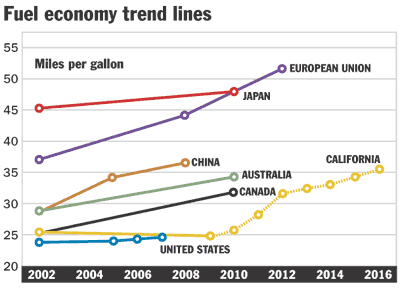
Automobile fuel efficiency has garnered lots of public attention in the last two years. The public's taste for gas guzzling trucks and SUV's is diminishing as the price of operating these vehicles soars with record gas prices. But are our cars fuel efficient enough? By comparing our fuel economy standards with our peer nations the picture becomes very clear that consumers in America are being taken on a ride (no pun intended) by the auto manufacturers.

Our European neighbors have set a standard of 47mpg for gasoline vehicles and 52mpg for diesel vehicles. Currently the US fuel standards sit at 27.5mpg with a goal of 35mpg by 2020. A look at the number of vehicle models sold in the United States that achieve combined gas mileage of at least 40 miles per gallon actually has dropped from five in 2005 to just two in 2007 — the Honda Civic hybrid and the Toyota Prius hybrid.

Overseas, primarily in Europe, there are 113 vehicles for sale that get a combined 40 mpg, up from 86 in 2005. Combined gas mileage is the average of a vehicle’s city and highway mpg numbers. Adding insult to injury is the fact that nearly two-thirds of the 113 highly fuel-efficient models that are unavailable to American consumers are either made by U.S.-based automobile manufacturers or by foreign manufacturers with substantial U.S. sales operations, such as Nissan and Toyota.

So on the surface it seems that automakers have the ability to push fuel efficiency to the limit but the products are just not reaching the customers. Interestingly enough, Shell, one of the big, bad oil companies holds a competition every year (Eco-marathon) where teams build the most fuel efficient cars they can and have a race on one gallon of gasoline to see who can push their car the farthest. The team from the French technical school St. Joseph La Joliverie went 7,148 miles on a single gallon of fuel...the Shell website is quick to point out that that's "almost ten miles per teaspoon". Wow! Are you kidding me, 7,000 miles on one gallon of gasoline. That should really give you an idea of just how much power there is in a single gallon of fuel. And it should point out how little auto makers are doing to increase fuel economy.

The competition is obviously stretched to the extreme with cars that look more like surfboards with a canopy but the idea is there. I understand why Shell does this, I'm not trying to paint them as saints, but they want to be able to go to the market and say, "hey look what some engineers did with one gallon of our product, don't blame us for fuel costs and inefficiency."

And to tell you the truth I can't blame the oil companies. Although we do need to reduce our dependence on foreign oil (if only for economic reasons if you're not so much into the environmental side of it). Even "X prize" is getting involved (famous for there commercial space flight competition) with a $10M prize "to create a commercially viable car that gets at least 100 miles to the gallon". Peter Diamandis, CEO of the X Prize Foundation says, "we're not talking about concept cars...we're talking about real cars that can be brought to market." Even Congress has jumped on the bandwagon issuing a resolution praising the Automotive X Prize. Now lets hope they look on the other side of the issue and denounce the efforts of the big auto makers and make them do something about it.

More After the Fold...

0 comments:

March 20, 2008

HA HA!

Justice, in some small measure. I'm surprised it took this long.

Oh man, I know this doesn't even come close to enough, and it sheds no additional light upon the murky clouds surrounding the Valerie Plame Outing and Cheney's Lair Office, but it does feel damn good to see Scooter get some amount of comeuppance.

More After the Fold...

0 comments:

Content Slowdown

Its my favorite time of year! March Madness has begun and unfortunately between watching the games, going to work, and blogging something has to give. So for the next few days the blogosphere is going to miss my ramblings. I'll try to put up at least one new post a day, but I'm not promising anything. Gig 'Em Ags!

More After the Fold...

0 comments:

March 19, 2008

RecycleBank raises $30M

The most low-tech of clean technologies, recycling, got a boost today. RecycleBank, a Philadelphia-based startup that runs incentive-based recycling programs, has raised $30 million in Series B funding led by the high-profile VCs at Kleiner Perkins, PEHub reports. RecycleBank’s round also included existing investors RRE Ventures and Sigma Partners, who together invested $13.1 million in a Series A financing last year.


RecycleBank seeks to revitalize municipal recycling by incentivizing the program for consumers. The more a customer recycles, the more “RecycleBank Dollars” he or she earns, which can be redeemed for discounts at over 250 different businesses. So by recycling more beer bottles, newspapers and shampoo bottles you can get discounts on Jockey underwear, Starbucks lattés or even PetCo dog food.

The way it works is your recycling container contains a unique RFID in which you can recycle glass, plastic, metal, paper and cardboard. The recycling trucks identify each container and weigh the contents, crediting the household. Customers can track and manage their recycling and rewards through RecycleBank’s web site.

Making the recycling business a profitable one is a tall order. Amid a budget crisis in 2002, New York City stopped recycling glass and plastic altogether because the program was losing too much money (the Big Apple has since resumed recycling). But RecycleBank is all too aware of what a volatile market it can be; it points to the most recent Annual Nationwide Survey of Solid Waste Management in the U.S., which notes that 28 states have seen recycling rates go down since 2001.

RecycleBank makes its money from the municipalities themselves, who pay based on number of household involved. The company also gets a cut from the recyclers, assuming they see a boost in materials coming in.

Early pilot programs turned in some impressive recycling adoption rates. In two Philadelphia communities RecycleBank boosted recycling rates to 90 percent each, up from 35 and 7 percent, respectively.

Now the only real problem I see with this sort of business plan is theft. And to tell you the truth if theft of recycling bins, or midnight runs to steal your neighbors recyclables, is the problem then it means the system is working. I know that my house has started recycling and not many other people really do. I have been by myself many times in the parking lot of Wal Mart sorting through my different recyclables. This is only a good thing, and by the early numbers it really was an incentive that people will get behind and support.

More After the Fold...

0 comments: